
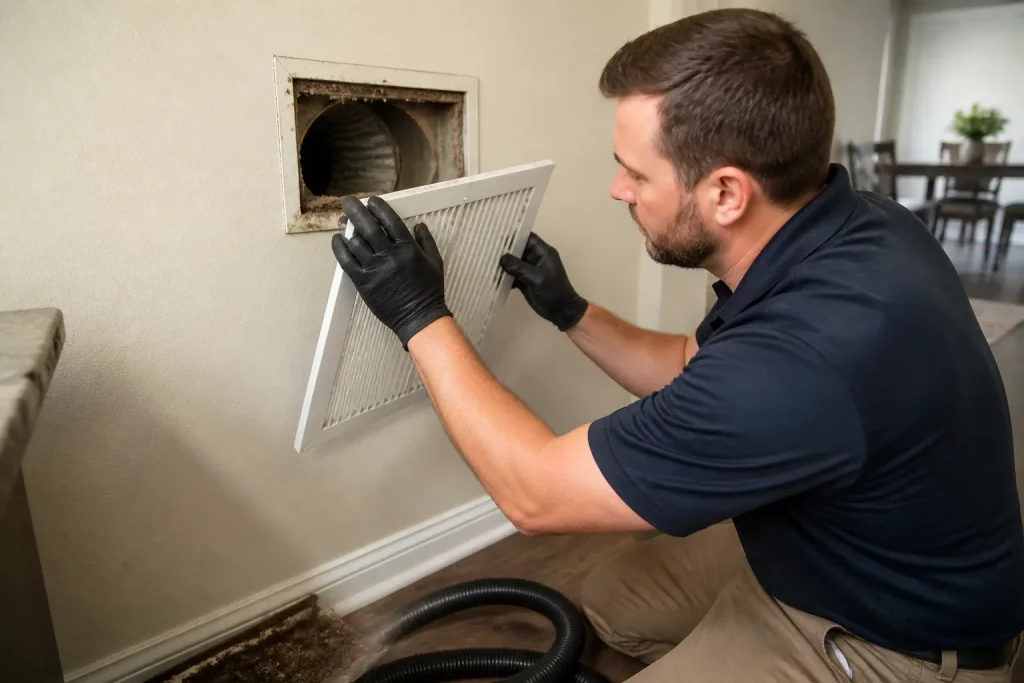
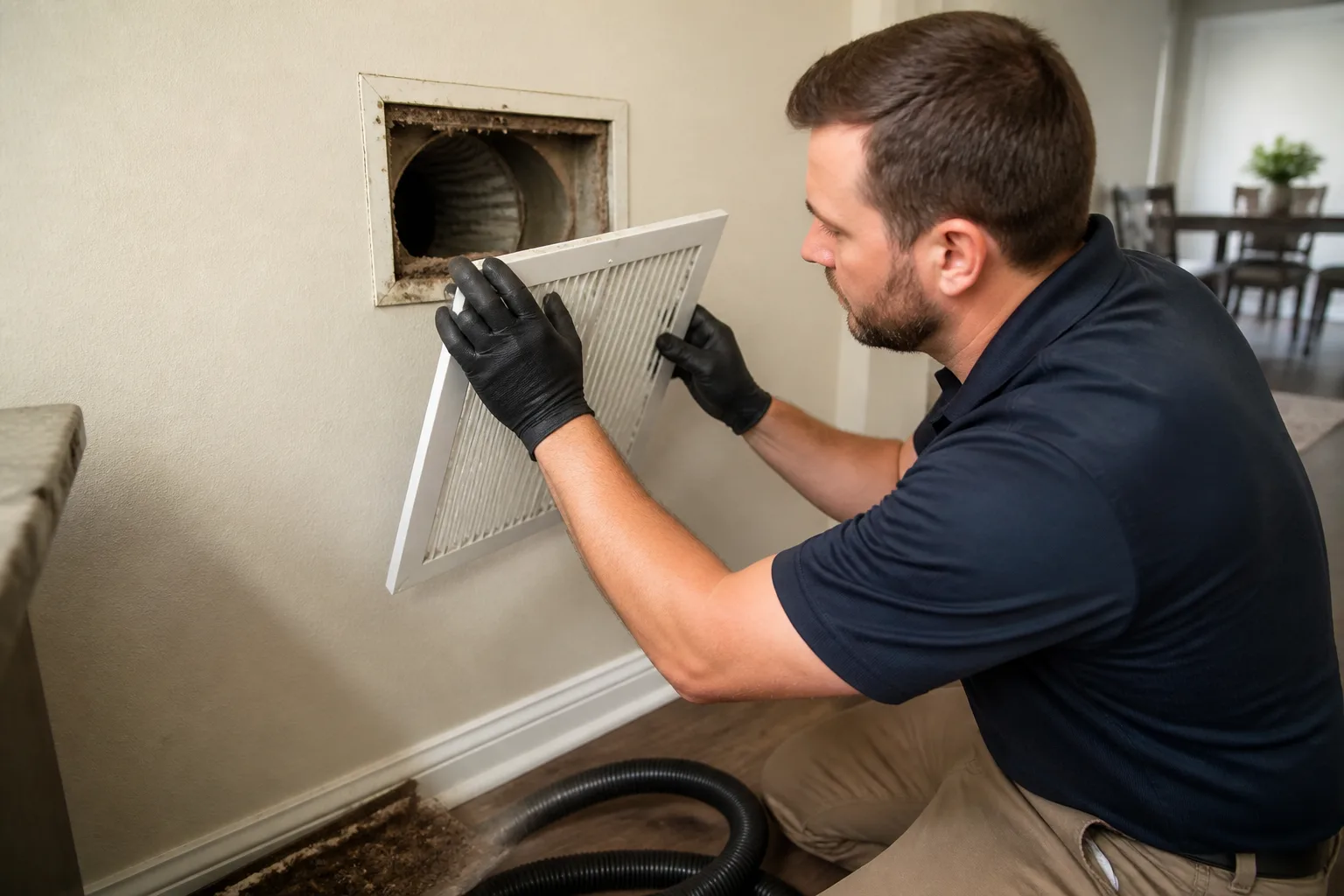
Emergency Air Duct Cleaning Near Me: What Northglenn Homeowners Should Do First
Most people searching “emergency air duct cleaning near me” in Northglenn have already made one mistake: they ran the HVAC after the event. That single instinct, running the system “just to see if it helps,” can push smoke particles, mold spores or pathogen-laden debris through every room in the house. A real duct emergency is fire or smoke damage, sewage intrusion, confirmed rodent nesting or post-flood mold. Everything else is a standard cleaning job that feels urgent. If you’d rather not sort it out alone, call (855) 726-7093.
Key Takeaways
- Turn the system off at the thermostat and the breaker before you call anyone.
- What makes it an emergency is contamination, not odor or dust.
- Tell the dispatcher the source of the contamination so the right equipment arrives.
- Be skeptical of flat quotes given sight-unseen over the phone.
- In Northglenn, wildfire smoke and frozen condensation lines are the two most common triggers.
What Actually Counts as a Duct Emergency in Northglenn?
A duct emergency is a contaminant inside the air pathway that is actively spreading or biologically active. Smoke and soot after a fire, sewage that backed up into floor registers, a confirmed rodent nest in a trunk line, or mold growth after a flood. Those four situations justify fast action. Dust, a musty smell in one room, or a filter you forgot to change do not.
The distinction matters because it changes what a crew brings and how the work is contained. A standard residential cleaning visit assumes ordinary household dust. A contamination event assumes the opposite: that anything disturbed will become airborne and land somewhere it shouldn’t.
Here in Northglenn, two local patterns push ordinary jobs into emergency territory. Summer wildfire smoke along the Front Range gets pulled into return ducts and settles on interior insulation and coil surfaces, where the smell returns every time the fan runs. In winter, a condensation line or drain pan that freezes and then thaws can leave standing moisture inside the air handler, and that moisture is exactly what mold needs. Neither situation is visible from the register. Both get worse the longer the system runs.
If you’re unsure which category you’re in, describe what happened rather than what it smells like. “The basement flooded two inches over the furnace” tells us far more than “the air smells weird.”
The First 30 Minutes: Shut the System Down
Turn off your HVAC at the thermostat first, then at the breaker that serves the air handler or furnace. Do this before you call anyone, including us. Running the fan moves contaminated air from the affected area into every duct branch in the house, and duct systems are not designed to be self-cleaning once something has settled inside them.
- Thermostat to OFF. Not to “fan on,” not to a lower temperature. Off.
- Breaker off. Find the breaker labeled for the furnace or air handler and switch it. This protects anyone working near wiring.
- Close registers in unaffected rooms if the contamination is localized, which limits how much air can migrate.
- Don’t run a shop vac or box fan near the affected area. Consumer vacuums lack HEPA filtration and will redistribute fine soot and spores.
- Photograph what you see before anything is cleaned. It helps with insurance and helps the crew plan.
Why does running it “just for a minute” compound the problem? Because a duct system is a loop. Whatever enters the return side gets distributed to supply registers across the whole house within seconds of the blower starting. Soot that was concentrated in one return chase becomes a fine film on every coil fin and every run of flex duct. That’s the difference between cleaning one section and cleaning the entire air pathway from intake to vent.
One more thing: if the event involved fire, gas, or standing water near electrical components, treat that as a safety issue first. Don’t open panels or reach into the air handler yourself. Electrical and gas work belongs to a trained professional, and we’ll say so plainly rather than talk you into something we shouldn’t.
What to Tell the Dispatcher So the Right Equipment Shows Up
Give the dispatcher three things: the source of the contamination, when it happened, and whether the system has run since. Those three answers determine whether a crew arrives with negative air machines, HEPA vacuums and antimicrobial treatment, or with standard cleaning equipment that isn’t built for containment.
Containment is the part most homeowners don’t know to ask about. When we handle a contamination event in Northglenn, the setup typically includes Abatement Technologies air filtration and containment equipment to hold particles while the work happens, HEPA vacuuming of surfaces and duct interiors, and mechanical agitation with Rotobrush and Nikro systems to loosen what has bonded to duct walls. Cleaning without containment just moves the problem into the room you’re standing in.
Useful details to have ready:
- Source: fire, smoke, sewage, rodents, water intrusion, or something you can’t identify.
- Timing: how long ago it happened, and whether the system has run since.
- Scope: one room, one floor, or the whole house.
- Materials: flex duct, rigid metal, or a mix, if you know.
- Access: where the air handler sits and whether the attic or crawlspace hatch is clear.
We answer 24/7. Fast dispatch, 7am-7pm, Sunday through Friday. That means you can call at two in the morning, describe the situation while it’s fresh, and get booked into the next opening with the right equipment noted on the job. Calling immediately also means you’re not making decisions in a panic later.
For routine work rather than a contamination event, air duct cleaning covers the standard whole-system approach, and it’s a scheduled job rather than an emergency one.
Why Northglenn’s Climate Changes the Emergency
Northglenn sits on the Front Range, which means two seasonal pressures most generic duct cleaning advice ignores. Summer wildfire smoke carries fine particulates that settle into return chases and interior insulation, and the smell resurfaces every time the blower runs. Winter brings freeze-thaw cycles that can crack or block a condensation line, leaving moisture inside the air handler where mold establishes quietly.
That local pattern changes what “emergency” means here. A smoke event isn’t over when the sky clears; the residue is still in the system. A frozen line isn’t fixed by a thaw; the moisture it left behind needs to be addressed. Homes in Northglenn with a whole-house humidifier wired into the system add another variable, since the water panel and distribution tray can harbor growth if they’ve been sitting wet. Aprilaire and Honeywell components are common in local homes, and they need to be checked as part of the same visit rather than treated as a separate afterthought.
Duct condition matters too. Older flex duct in a Northglenn attic takes a beating from temperature swings, and a tear or disconnected joint lets attic air and insulation fibers into the supply side. A crew that only cleans and doesn’t inspect for damage will leave a gap that recontaminates the system within weeks. We repair and seal, not just clean, because a sealed system is the only kind that stays clean.
Red Flags in Emergency Duct Cleaning Ads
The biggest red flag is a flat price quoted sight-unseen over the phone. Nobody can price a contamination event without seeing the source, the duct material and the access. A number given before anyone looks is a number designed to get a technician through your door, and it rarely survives contact with the actual job.
Watch for these:
- Flat quotes without an inspection. A written estimate should come after someone assesses the system.
- No mention of verification. Ask how they’ll confirm the work was done. Before-and-after photos of your own ducts are the minimum, and post-cleaning verification matters more after a contamination event.
- No containment plan. If the answer to “how will you keep this from spreading?” is vague, that’s your answer.
- Cleaning without inspection for damage. A company that doesn’t check for tears, disconnected joints or crushed runs is only doing half the job.
- Pressure to decide immediately. Urgency is real in a genuine emergency, but a legitimate operator will still explain the scope before quoting.
One flat price per system, agreed in writing before work starts, is the standard to hold anyone to. No per-vent math, no teaser coupon that triples at the door. The written estimate sets the final price.
When to Call a Pro (and When to Just Schedule)
Call a professional now if the contamination is active or biological: sewage in the ducts, a rodent nest, visible mold, or soot from a fire. Those situations need containment equipment and, in some cases, antimicrobial treatment with products like Guardsman that meet professional standards. Don’t open the air handler and start wiping. Fine soot and spores go airborne the moment you disturb them, and a mask from the hardware store isn’t containment.
Schedule a normal appointment if you’re dealing with dust, allergies, a recent move-in, or a system that’s never been inspected. That’s not an emergency, and treating it like one just adds stress. Our technicians have up to 10 years of experience and can tell you during the visit whether the system needs more than cleaning.
Two adjacent services belong in the same conversation. If the event involved water near the mechanical equipment, HVAC cleaning addresses the coil and air handler, where moisture and residue collect. And if you’ve never had the dryer vent inspected, dryer vent cleaning removes a genuine fire hazard that has nothing to do with your air quality but everything to do with your safety. As a rule of thumb, most homes do well with a professional look every few years, sooner if you’ve had pets, renovations or a contamination event.
Related services in Northglenn: air duct cleaning, dryer vent cleaning, HVAC cleaning, duct repair and sealing, and air quality and sanitizing. Five categories under one contractor means one accountable point of contact from intake to vent.
The Bottom Line
In a real duct emergency, the first thirty minutes matter more than which company you call. Shut the system off at the thermostat and the breaker. Don’t run fans or consumer vacuums. Photograph what you see. Then call and describe the source, not the smell, so the crew arrives with containment and HEPA equipment rather than a standard residential setup.
Northglenn’s wildfire smoke season and freeze-thaw winters make both scenarios more common here than generic advice suggests. And whatever you do, don’t accept a flat price quoted before anyone has looked at your system.
If you’re in Northglenn and need help, Northglenn Air Duct Cleaning offers free estimates. Call (855) 726-7093. We answer 24/7. Fast dispatch from 7am to 7pm, Sunday through Friday. One flat price per system, agreed before work starts, with before-and-after photos of your own ducts.
Frequently Asked Questions
It depends on the size of the system, the number of runs and whether contamination is involved, which is why we price per job after a written estimate rather than quoting a number over the phone. A standard whole-system cleaning and a post-fire containment job are not the same scope. Call (855) 726-7093 for an exact quote. Estimates are free.
No. Running the blower distributes whatever is in the return side to every supply register in the house within seconds. Turn the thermostat to off and switch the breaker for the air handler before doing anything else. A minute of running can turn a one-section cleaning into a whole-system job.
Ask for before-and-after photos of your own ducts, not stock images, and ask how they verify results after a contamination event. A crew using Rotobrush and Nikro equipment with proper containment can show you what came out and what the interior looks like after. If a company can’t show you either, keep looking.
Usually because the quote was given before anyone saw the system, and it changes once a technician is on site. It can also mean no containment equipment, no HEPA filtration and no inspection for damaged ductwork, which leaves the contamination source in place. A written estimate after an assessment is the only number worth comparing. Call (855) 726-7093 to get one.
Keep the system off, keep people and pets out of the affected area, and avoid running any fan or vacuum near it. If the event involved fire, gas or water near electrical components, stay out of the mechanical space entirely and let a trained professional handle it. Call (855) 726-7093 and we’ll book you into the next dispatch opening, Sunday through Friday, 7am to 7pm.
Written by the team at Northglenn Air Duct Cleaning.
Need Air Duct Cleaning Help?
Call Northglenn Air Duct Cleaning - the local pro we connect you with is licensed and insured, with free written estimates in Northglenn.
(855) 726-7093